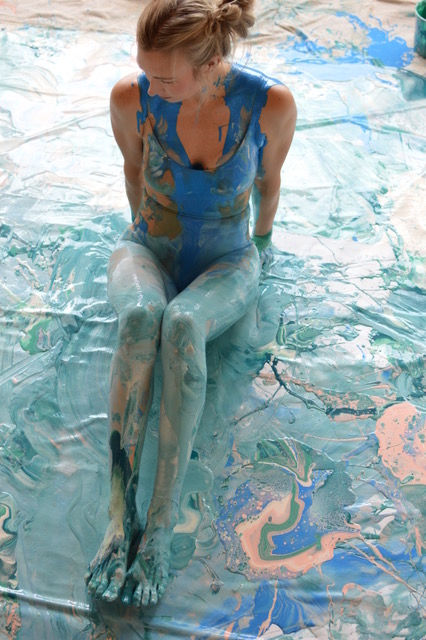
About Julia
I’ve been a psychotherapist and an entrepreneur, but in recent years, I’ve discovered that the canvas holds a space for the same conversations I’ve held in my therapy room. My art is both a dialogue and a dance—between the parts of ourselves we cherish and the parts we often hide.
I came to painting through my own resistance—my inner critic told me for years that I wasn’t “good enough” to create. But art became a vehicle to sit with that critic, not to silence it, but to engage in dialogue. Now, I paint as an invitation—to myself and to others—to create, even when the inner voice says otherwise.
In my practice as a mental health therapist, I’ve spent years helping people integrate grief and joy, shadow and light. My painting, too, explores these dualities. I love playing with rich, moody tones that hold space for grief, paired with bright, airy hues that reflect joy and hope. Each piece is a reflection of the full human experience.
Embodiment is central to both my therapy and my creative process. Through movement, breath, and the physical act of pouring or shaping paint, I reconnect with myself. My studio is a space to face resistance—not to fight it, but to move with it.
The duality of grief and life is something I know intimately, and I hope that my art provides a space for others to see their own light and shadow with compassion. In each brushstroke, I’m inviting myself—especially when I’m working with my inner critic and emotion—to create anyway.
As a mother, an advocate for women, and a perpetual explorer of inner and outer landscapes, my mission is simple: to remind us all of the beauty in showing up—even in the messy, imperfect, and raw moments. Whether through paint or through conversation, I hope to offer a space where we can hold all of it—grief and joy, doubt and delight—and create something meaningful along the way.
In my art, the creation itself is the only goal. I paint not to produce a final piece, but to immerse myself in the process—where each brushstroke or pour is an exploration in being fully present. I protect that experience from the weight of production. Each moment I create, I welcome imperfection and curiosity—knowing that what matters most is that I showed up and gave myself permission to explore.
My journey into art began in the wake of loss. As a widowed parent, I’ve navigated the intertwined paths of grief and love, dark and light. Parenthood, too, is a space of contrasts—moments of deep challenge and profound joy. Through these experiences, I’ve found that embodiment—feeling into my body, my breath, my movement—allowed me to hold both realities at once. My art, much like my life, is a testament that light and dark always coexist—and that neither diminishes the other. In sharing my work, I hope to inspire other widowed parents to embrace both their grief and their joy—through creative expression, movement, or simply giving themselves permission to show up.
In the act of creation, I meet my own resistance head-on. Like the wisdom from ancient strategies, I’ve learned that the obstacle is not a barrier—it is the path. By understanding my inner resistance, I turn it into a guide. It takes courage to create—not because the result matters, but because showing up to the unknown is an act of bravery in itself. In each moment of presence, I embrace both the shadow and the light, knowing that this duality is where life happens.
My journey, shaped by both grief and joy, has taught me that we all walk this path. As a parent, a therapist, and a fellow human, I’ve found that embracing embodiment—our breath, our movement, our senses—allows us to hold both the dark and the light. My art is a reflection of this wholeness. We all live in human bodies, sharing human experiences—life and death, loss and love. When we have the courage to meet our experiences, we can hold one another’s, too. In sharing my art, I hope to inspire others to recognize that we cannot have one without the other—and that it’s in this balance that we find our shared humanity.